

Navigating Rental Car Fines in Dubai: The 2026 Expert Guide
September 7, 2026
Meydan Dubai 3-Day Itinerary & Real Costs (2026 Guide)
September 7, 2026
Dubai Transport Guide 2026
Getting Around Dubai in 2026: Car Rental vs Taxi vs Metro
A practical comparison of Dubai Metro fares, RTA taxi rates, Salik tolls, Parkin charges and car rental costs — with a dedicated section for visitors staying in Meydan, where there is no Metro station.

The cheapest way to get around Dubai in 2026 is the Metro, at AED 3 to AED 7.50 per journey with a Silver nol card. A taxi is the most convenient for one-off door-to-door trips, starting at AED 5 with a AED 12 minimum fare. A rental car becomes the practical choice once you make three or more trips a day, travel with luggage or children, or stay somewhere the Metro does not reach — which includes Meydan, an area with no Metro station of its own.
That one-paragraph answer covers most visitors. The rest of this guide shows you the official 2026 numbers behind it, how they change once Salik, Parkin and fuel are added, and four realistic itineraries where the answer flips from one option to another.
What this guide covers
- Metro vs taxi vs rental car: the 2026 comparison
- Dubai Metro and nol fares
- Dubai taxi fares, Hala, Careem and Uber
- Is renting a car cheaper than taking taxis?
- A worked one-day cost comparison
- Four real travel scenarios
- Getting around from Meydan without a Metro station
- What you need to rent a car in Dubai
- Salik, Parkin, fuel and the costs people forget
- Frequently asked questions
- Key takeaways and sources

Dubai Metro vs Taxi vs Rental Car: the 2026 Comparison
Choosing transport in Dubai is really a question about three things: where you sleep, how many separate journeys you make in a day, and how much of your itinerary sits outside the Red and Green Line corridors. A visitor staying beside Burj Khalifa/Dubai Mall station and a visitor staying in Nad Al Sheba or Meydan are living in two different cities from a transport point of view.
| Option | Best suited to | What you actually pay | Main limitation |
|---|---|---|---|
| Metro, tram and bus | Solo travellers and couples staying near a station | Silver nol: AED 3, 5 or 7.50 per journey by zone | Station access, transfers and first/last-mile taxis |
| RTA taxi, Hala, Careem | Airport transfers, evenings out, occasional direct trips | From AED 5 flagfall, AED 12 minimum, then distance and waiting | Every extra journey adds a new fare |
| Rental car | Families, Meydan stays, multi-stop days, trips out of Dubai | Daily rate plus fuel, Salik, parking and any agreed extras | Licence eligibility, deposit, traffic and parking zones |
| Mixed approach | Itineraries split between central and outlying areas | Public transport most days, a car on the days you need one | Needs a little more planning |
One correction worth making early, because it appears in a lot of travel advice: a standard Dubai taxi carries up to four passengers, so a family of four does not pay four fares. The real reason a car wins for families is not headcount — it is the number of separate journeys, luggage and child seats, and the freedom to leave a restaurant or a beach without waiting for a booking to be accepted.

Dubai Metro and Nol Fares: the Budget Baseline
The Metro is the cheapest way to move between connected areas, and for a solo visitor it is very difficult to beat. Fares are zonal, not distance-based, and the same nol card works on the Metro, the tram, public buses and the water bus.
| Journey | Silver nol card | Red Ticket |
|---|---|---|
| Within one zone | AED 3 | AED 4 |
| Two adjacent zones | AED 5 | AED 6 |
| More than two zones | AED 7.50 | AED 8.50 |
| Gold Class cabin | Double the standard fare for the same journey | |
Source: RTA published nol journey fares. These are travel fares, not the price of the card itself.
Four things visitors get wrong about nol cards
- The card is a separate cost. A Silver nol card is sold for AED 25 and includes AED 19 of usable travel credit.
- You need a minimum balance to tap in. Keep at least AED 7.50 on the card, because that covers the highest single-journey fare on the line.
- Transfers are one journey, not two. Changing between Metro, tram and bus within RTA’s 30-minute transfer window is charged as a single zonal journey rather than two separate fares.
- Always tap out. If you forget, the system charges the maximum fare for the line.
How Much Do Taxis Cost in Dubai in 2026?
Dubai taxis are metered, regulated by the RTA and easy to use, whether you hail one on the street or book through Hala in the Careem app. What confuses visitors is that the number they see when the meter starts is not the number they pay: the flagfall, the per-kilometre rate, waiting time, the minimum fare and any Salik crossings are five separate components.
| Fare component | 2026 rate | Notes |
|---|---|---|
| Street-hail flagfall | AED 5.00 daytime / AED 5.50 night | Daytime 6am–10pm, night 10pm–6am |
| Airport pickup at DXB | AED 25 flagfall | Applies at the official airport taxi ranks |
| Per kilometre | Around AED 2.19 | Fuel-linked and revised monthly, roughly AED 2.14–2.26 |
| Waiting time | AED 0.50 per minute | This is why rush-hour trips cost more than the map suggests |
| Minimum fare | AED 12 street hail / AED 13 app booking | Charged even on very short trips |
| Salik crossings | Added to the meter | Priced at the rate applying when you cross the gate |
Source: RTA taxi tariff structure. App bookings also carry a booking surcharge that varies by peak and off-peak periods.
Hala vs Careem vs Uber
Hala dispatches regulated RTA taxis and generally follows the standard taxi tariff plus a booking surcharge, which makes it the value option for most visitors. Careem’s private car categories and Uber sit above it as premium services with their own pricing. Street taxis cost the same as Hala without the surcharge — but you have to find one, which is the trade-off on a 42°C afternoon in Meydan or Al Quoz.
What a real Dubai taxi trip works out at
Applying the official rates: a 10 km daytime journey with about five minutes stuck at lights costs roughly AED 5 flagfall + AED 21.90 distance + AED 2.50 waiting, so around AED 29 before any Salik gate. Add one peak crossing and you are near AED 36. Scale that across four journeys in a day and the arithmetic starts to favour a car — which is exactly the calculation the rest of this guide works through.

Is Renting a Car Cheaper Than Taking Taxis in Dubai?
It can be, and the tipping point is easier to identify than most guides admit. Taxi cost is variable: every journey adds a new flagfall, a new distance charge and, in traffic, a new waiting charge. A rental rate is fixed for the day whether you drive to one place or seven.
In practice, a car starts to make financial sense when your day includes three or more paid journeys, and it makes obvious sense when your itinerary leaves the Metro corridor entirely — a beach morning, a mall afternoon, dinner in another district, a day trip to Abu Dhabi or Hatta.
| Your day looks like this | Sensible choice |
|---|---|
| One or two journeys, both near stations | Metro, with a taxi if you are late |
| Two or three journeys, one of them outside the corridor | Metro plus Hala |
| Three or more journeys, luggage, children or heat | Rental car |
| Leaving Dubai for the day | Rental car, without much debate |
Meydan Car Rental’s published starting rates begin at AED 142 per day for a compact SUV such as the Nissan Kicks, with seven-seaters from AED 218 per day. If your trip is mostly city driving and short hops, browse the economy car rental options in Dubai first — they are the cheapest to run and the easiest to park in Downtown and Business Bay multi-storey car parks.

A Worked One-Day Comparison
Here is the same day priced three ways: two adults staying in Meydan, four separate journeys — Dubai Mall in the morning, lunch in Business Bay, an afternoon at Jumeirah, dinner back near the hotel. Every figure below is built from the official rates already quoted in this guide, with the assumptions written out so you can substitute your own.
| Option | Assumptions used | Illustrative day total |
|---|---|---|
| Metro plus taxi connections | 2 adults × 2 three-zone journeys at AED 7.50, plus two taxi connections to and from Business Bay station at about AED 30 each | AED 90 |
| Taxis only | 4 metered journeys averaging 12–18 km with typical waiting time, one peak Salik crossing | AED 150–180 |
| Compact SUV rental | AED 142 rental + about 70 km of fuel at AED 3.69/litre (≈ AED 21) + two off-peak Salik crossings (AED 8.40) + three hours of standard parking (≈ AED 12.60) | ≈ AED 184 |
For two adults on one ordinary day, the Metro combination is genuinely the cheapest and the taxi day is the middle option. The car is a little more — and it also carries unlimited additional journeys at zero marginal cost, waits for you at the beach, keeps the air conditioning running and holds the shopping. Add a fifth or sixth trip, or a third and fourth passenger, and the ranking inverts by the end of the day.
Four Real Travel Scenarios
Averages hide the decision. These four itineraries cover most visitors, and the right answer changes in each one.
1. Solo traveller, three days, hotel near the Red Line
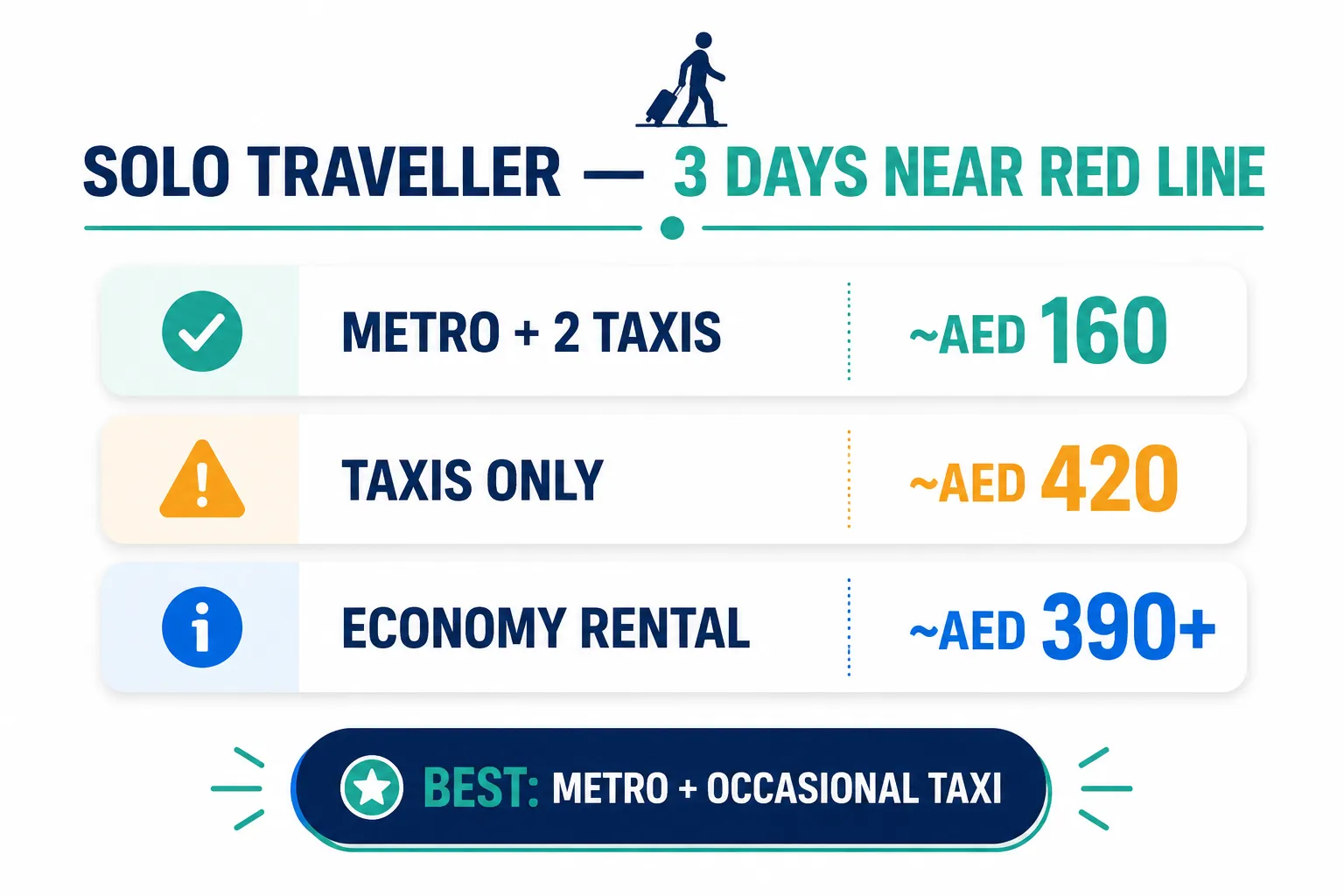
Best option: Metro, with occasional taxis. Three days of zonal fares plus a handful of evening taxis lands well under AED 200 in total. Renting only makes sense here if you plan to leave the city for a day — in which case rent for that day alone rather than the whole stay.
2. Couple, five days, hotel in Downtown Dubai
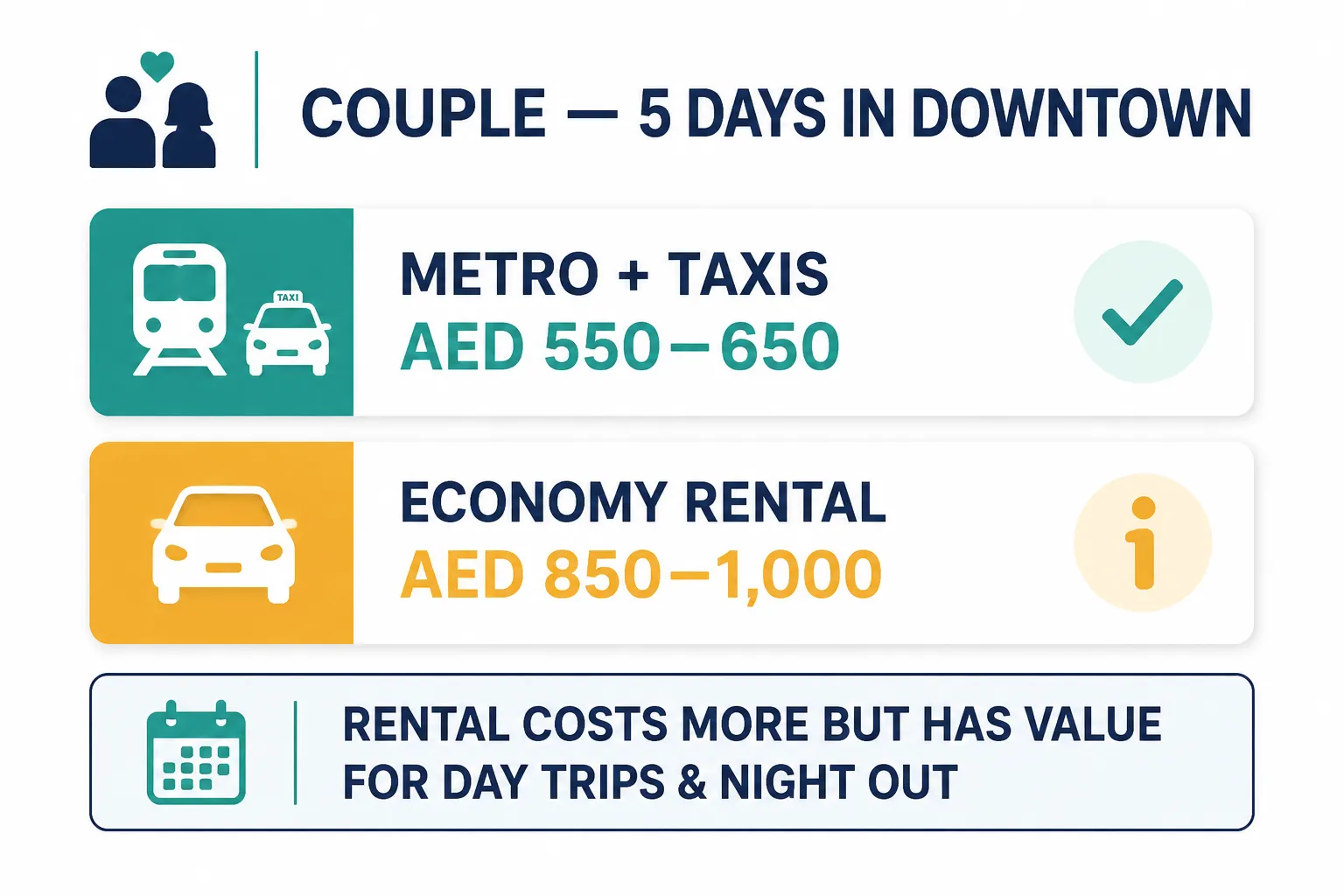
Best option: mixed, and it is close. Downtown is well served, so daytime travel on the Metro with taxis after dark typically runs AED 90–130 a day for two people. A compact rental with fuel, tolls and parking runs closer to AED 180–200 a day. The extra buys convenience and a spontaneous drive to Jumeirah, Al Qudra or Hatta; if your five days are Downtown-centric, keep the money.
3. Family of four, seven days
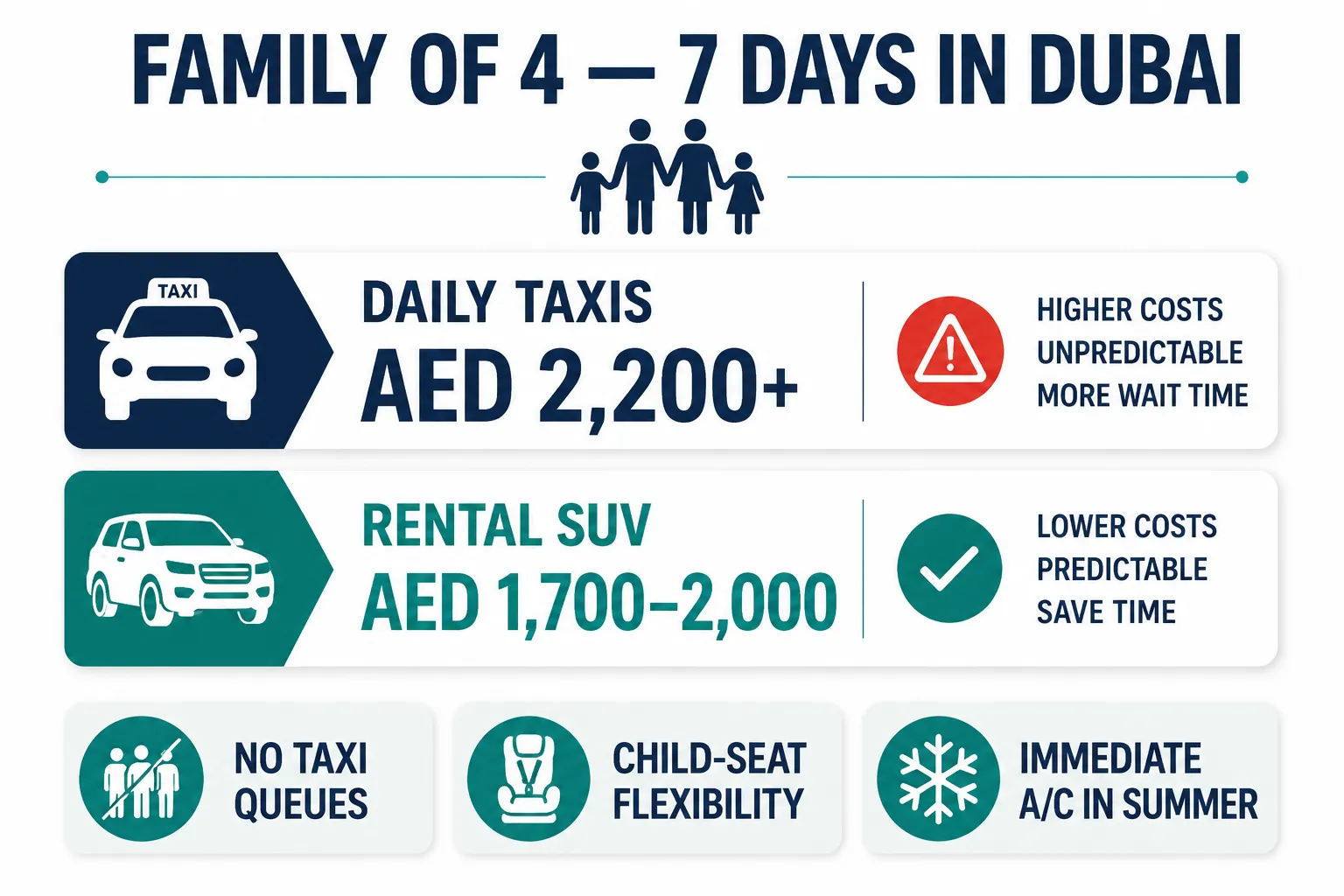
Best option: rental car. On pure fares the two options are closer than you would think, because one taxi carries the whole family. What separates them is everything else: four or five journeys a day rather than two, luggage and beach kit, child seats you control, and no waiting outside Miracle Garden at closing time with tired children in August heat. A seven-seater is worth pricing even for a family of four once you add grandparents, strollers or a week’s shopping — compare the family SUV rentals in Meydan Dubai before defaulting to the smallest car.
4. One-day trip from Dubai to Abu Dhabi
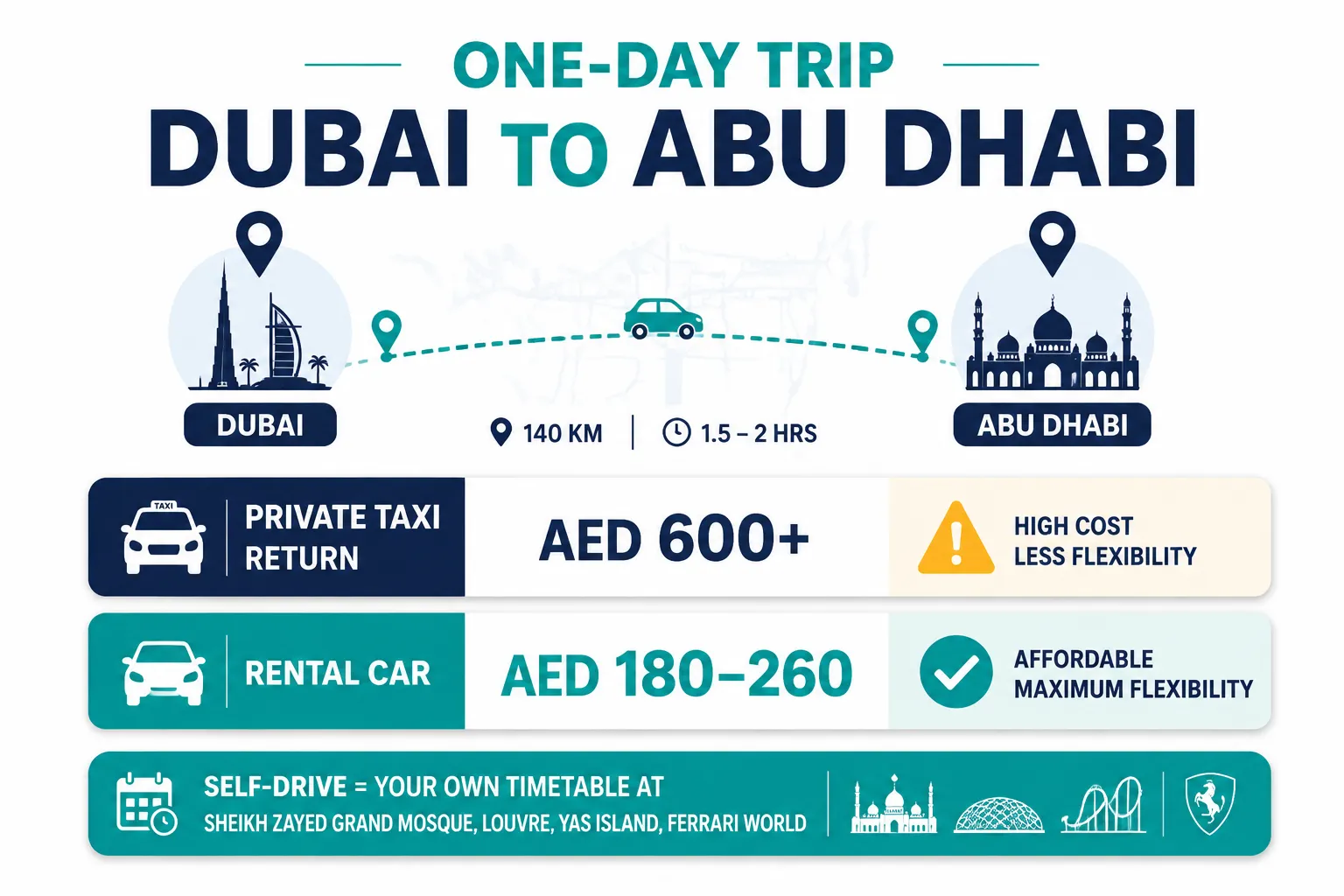
Best option: rental car, comfortably. Intercity taxi trips are priced in fixed distance bands and a return journey is expensive. A one-day rental with roughly 300 km of fuel, Dubai’s Salik gates and Abu Dhabi’s Darb tolls lands in the region of AED 250–300 for the whole car — and it lets you hold Sheikh Zayed Grand Mosque, Louvre Abu Dhabi, Qasr Al Watan and Yas Island in one day on your own schedule instead of a driver’s.

Getting Around From Meydan: the Transport Gap Nobody Warns You About
Meydan has no Dubai Metro station. That single fact reshapes the whole calculation for anyone staying at The Meydan Hotel, in Nad Al Sheba or in the surrounding residential clusters. Meydan sits close to Downtown Dubai and Business Bay by road, over Meydan Bridge and along Al Khail Road, but it is not walkable to the rail network in any season, let alone in summer.
For most guests the nearest practical station is Business Bay, and reaching it means a short taxi — typically 10 to 15 minutes depending on traffic and where in Meydan you are staying. Meydan covers a large area, so no single transfer time or taxi price fits every property; check the route from your exact address rather than from the district name.
When a rental car is the obvious answer in Meydan
- You are staying more than one full day and plan to actually explore Dubai.
- Your list includes Downtown Dubai and Dubai Mall, Dubai Marina and JBR, Palm Jumeirah, the Jumeirah beaches, Dubai Hills, Arabian Ranches, Global Village or Miracle Garden.
- You are travelling with children, a stroller or more than hand luggage.
- You are here for racing. On Dubai World Cup weekend and other event nights at Meydan Racecourse, demand for taxis spikes and pickup zones get congested after the last race.
- You want an early start at The Track, Meydan Golf, or a drive out to Hatta or Jebel Jais at the weekend.
If your stay is built around events, dining and executive travel rather than sightseeing, the luxury car rental range in Meydan covers the presentation side of that. For everything else, a compact SUV does the job for a fraction of the running cost.
Staying in Meydan this week?
Send us your dates, passenger count and luggage, and we will come back with an itemised quote — rate, insurance, mileage allowance, toll handling and delivery to your hotel, in writing before you commit.
What Do You Need to Rent a Car in Dubai?
Requirements vary by rental company, driver age and the country that issued your licence, but almost every visitor needs the same core documents ready before collection.
- Passport and, where the company asks for it, your UAE entry stamp or visa details.
- A valid driving licence from your country of residence.
- An International Driving Permit (IDP) where your licence is not recognised on its own.
- A credit card in the main driver’s name for the security deposit.
- Confirmation of any additional driver, which usually has to be approved and documented before the car leaves.
Visitors holding licences from countries covered by UAE recognition arrangements — including the UK, the United States, EU member states, Canada, Australia and the GCC — can often drive on their home licence, subject to the rental company’s own policy. Drivers whose countries are not covered by those arrangements, which includes many Iranian visitors, will generally need a valid International Driving Permit alongside the home licence.
Frequently Asked Questions
What is the cheapest way to get around Dubai?
The Metro, tram and bus network with a Silver nol card, at AED 3, AED 5 or AED 7.50 per journey depending on the zones you cross. Add the cost of reaching the station before comparing it with a taxi or a rental car.
Is the Dubai Metro cheaper than a taxi?
Yes, for journeys between areas the network actually serves. A three-zone Metro journey costs AED 7.50 while a 10 km taxi trip is closer to AED 29 before tolls. The advantage narrows sharply once you need taxis at both ends of every trip.
Does Meydan have a Metro station?
No. There is no operational Dubai Metro station in Meydan. Most guests use a taxi or a rental car for the full journey, or take a short taxi to Business Bay station and continue by rail.
How much is a taxi from Dubai Airport to Meydan?
Airport taxis start at an AED 25 flagfall and then run on the metered distance rate, so the total depends on your terminal, the exact address in Meydan and the traffic at the time. Use the RTA fare calculator or the booking app estimate for your specific arrival rather than a fixed figure.
Is renting a car cheaper than taking taxis in Dubai?
It can be once you make three or more journeys a day, but it is not automatic. Compare the full rental cost — rate, fuel, Salik, parking and any agreed extras — against the combined metered cost of the taxi journeys you would actually take.
Are Salik tolls included in the daily rental rate?
Do not assume they are. Salik charges AED 6.30 at peak times and AED 4.20 off-peak per crossing including VAT, and rental companies bill tolls separately, sometimes with a disclosed processing fee. Ask how tolls are handled before collection.
Do I need an International Driving Permit in Dubai?
It depends on the country that issued your licence. Some nationalities can drive on their home licence, while others — including many Iranian visitors — need an IDP alongside it. Confirm acceptance with the rental company before paying.
Can I drive a rental car from Dubai to Abu Dhabi?
Most companies allow it, but confirm cross-emirate permission, insurance terms, mileage limits and how Abu Dhabi’s Darb tolls are billed before you set off.
Can tourists explore Dubai without renting a car?
Yes, with limits. Downtown, DIFC, Deira, Bur Dubai, Dubai Marina, JLT and parts of Palm Jumeirah are workable on Metro, tram, monorail and taxis. Meydan, the Jumeirah beaches, Global Village, the desert and the other emirates are much easier with a car.

Key Takeaways
- Travelling alone and staying near a station: the Metro wins on price, every time.
- Occasional door-to-door trips, airport runs and nights out: Hala or a street taxi, with AED 12 as the floor on any fare.
- Three or more journeys a day, children, luggage or summer heat: a rental car stops being a luxury and becomes the sensible option.
- Staying in Meydan: there is no Metro station, so budget for road transport from the first day.
- Abu Dhabi, Hatta, Jebel Jais or a multi-stop day: rent, and price the Salik and Darb crossings into the day.
Explore Dubai on your own schedule
If your trip includes Meydan, the beaches, family travel or a day beyond Dubai, a car is usually the easier decision. Tell us your dates and we will send an itemised quote with no surprises at handover.
Sources and pricing methodology
Metro and nol journey fares and taxi tariff components are taken from RTA’s published schedules. Toll rates and the June 2026 VAT change are referenced to Salik’s own announcements. Parking tariffs and the VAT change are referenced to Parkin. Fuel prices are the UAE Fuel Price Committee rates for September 2026. Worked budgets in this guide are editorial calculations built on those rates, not live quotations.
- Roads and Transport Authority (RTA) — nol fares, taxi tariffs and journey planner
- Salik — variable toll rates and gate network
- Salik — VAT on toll tariffs from 1 June 2026
- Parkin — Dubai public parking zones and variable tariffs
- Dubai Airports — DXB terminal and ground transport information
- The UAE Government portal — driving licences and road rules
- Visit Dubai — official destination information
Disclaimer: fares, tolls, parking tariffs, fuel prices, licence requirements and rental policies change. The figures here are planning estimates current at the last update. Official operator notices, posted signage and your signed rental agreement take precedence.